
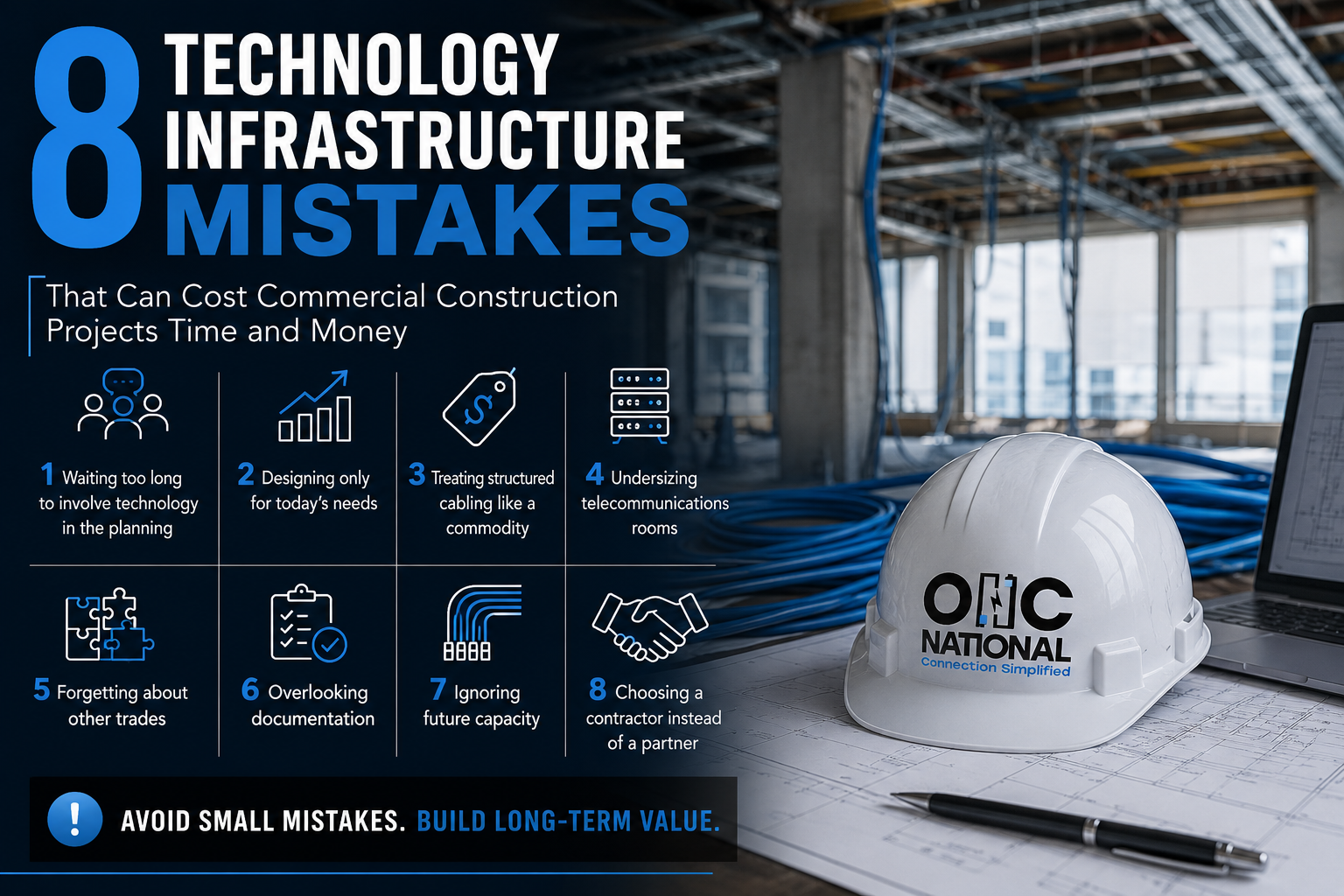
8 Technology Infrastructure Mistakes That Can Cost Commercial Construction Projects Time and Money
The best technology projects don’t happen by accident. They happen through thoughtful planning, coordination, and the right decisions long before a building opens its doors.
Every commercial construction project comes with its own challenges. Schedules shift. Multiple trades share the same space. Deadlines tighten. Through it all, technology infrastructure still must support the building long after construction crews have moved on.
Most costly technology issues are not caused by poor equipment. They are the result of decisions that seemed small during construction but became much more significant after the building was occupied.
Whether you are an owner, architect, engineer, or general contractor, avoiding a few common mistakes can save time, reduce change orders, and help create a building that is prepared for the future.
1. Waiting Too Long to Bring Technology Into The Conversation
Technology infrastructure shouldn’t be one of the last scopes discussed during a project. Industry organizations such as BICSI provides best practices for planning, designing, and installing information and communication technology infrastructure in commercial buildings.
By the time walls are framed and ceilings begin to close, options become more limited. Pathways may already be crowded, telecommunications rooms may be undersized, and coordination with other trades becomes more difficult.
Bringing your technology partner into the project during design or preconstruction gives everyone more flexibility and helps identify potential issues before they affect the schedule.
ONC Perspective: The earlier technology planning begins, the more opportunities there are to solve challenges before they become expensive field changes.
2. Designing Only For Today’s Needs
Commercial buildings often remain in service for decades. The technology inside them wont.
Security systems expand. Wireless coverage requirements increase. Additional devices are added. New software platforms and building technologies continue to evolve.
Infrastructure should provide room for growth instead of limiting it.
Planning for expansion today is usually far less expensive than renovating occupied spaces later.
3. Treating Structured Cabling Like a Commodity
Not all structured cabling systems are designed the same way. If you are new to structured cabling, read our article: What is Structured Cabling? The Foundation Behind Every Successful Commercial Building.
The quality of the design, installation, testing, documentation, and long-term planning all influence how well the infrastructure performs throughout the life of the building.
Choosing a contractor based solely on price can create challenges that are far more costly to correct later.
4. Undersizing Telecommunications Rooms
Telecommunication rooms are often viewed as spaces that simply house network equipment.
In reality, they need to support equipment today while allowing room for future growth.
Limited rack space, inadequate cooling, insufficient power, and poor cable management can all make future expansions more complicated than necessary.
5. Forgetting About Other Trades
Technology doesn’t exist in its own world.
Cable pathways, equipment locations, conduit, and ceiling space all need to be coordinated with electrical, HVAC, plumbing, fire protection, and architectural systems.
Good coordination helps prevent conflicts before crews arrive in the field. Building Information Modeling (BIM) has become an important coordination tool, helping project teams identify spatial conflicts before installation begins. Learn more about ANSI/BICSI BIM standards.
6. Overlooking Documentation
A successful project doesn’t end when the last cable is installed.
Accurate labeling, testing results, as-built drawings, and organized documentation make future maintenance and upgrades significantly easier.
Years from now, that documentation may become one of the most valuable deliverables from the entire project.
7. Ignoring Future Capacity
It is easy to focus on immediate project requirements.
It is harder, but far more valuable, to ask what the building may need five or ten years from now.
Additional conduit, spare fiber strands, extra rack space, and room for future pathways can provide flexibility without dramatically increasing construction costs.
8. Choosing a Contractor Instead of a Partner
Installing technology is one part of a successful project.
Helping owners, architects, engineers, and general contractors navigate planning, coordination, scheduling, testing, and closeout requires a broader perspective.
The right technology partner contributes throughout the project, not just during installation.
The Bottom Line
Technology infrastructure is one of the few building systems expected to support continuous change throughout the life of a facility.
Avoiding these common mistakes isn’t about creating the most advanced building. It is about creating one that is reliable, adaptable, and prepared for whatever comes next.
The best technology projects rarely stand out because everything went perfectly. They stand out because thoughtful planning prevented problems that never had the chance to happen.
Avoid Costly Mistakes Before Construction Begins
A conversation early in the project can prevent challenges later. If you are planning a commercial construction project, ONC National can help you develop technology infrastructure that supports long-term performance and future growth.