

What is Division 27?
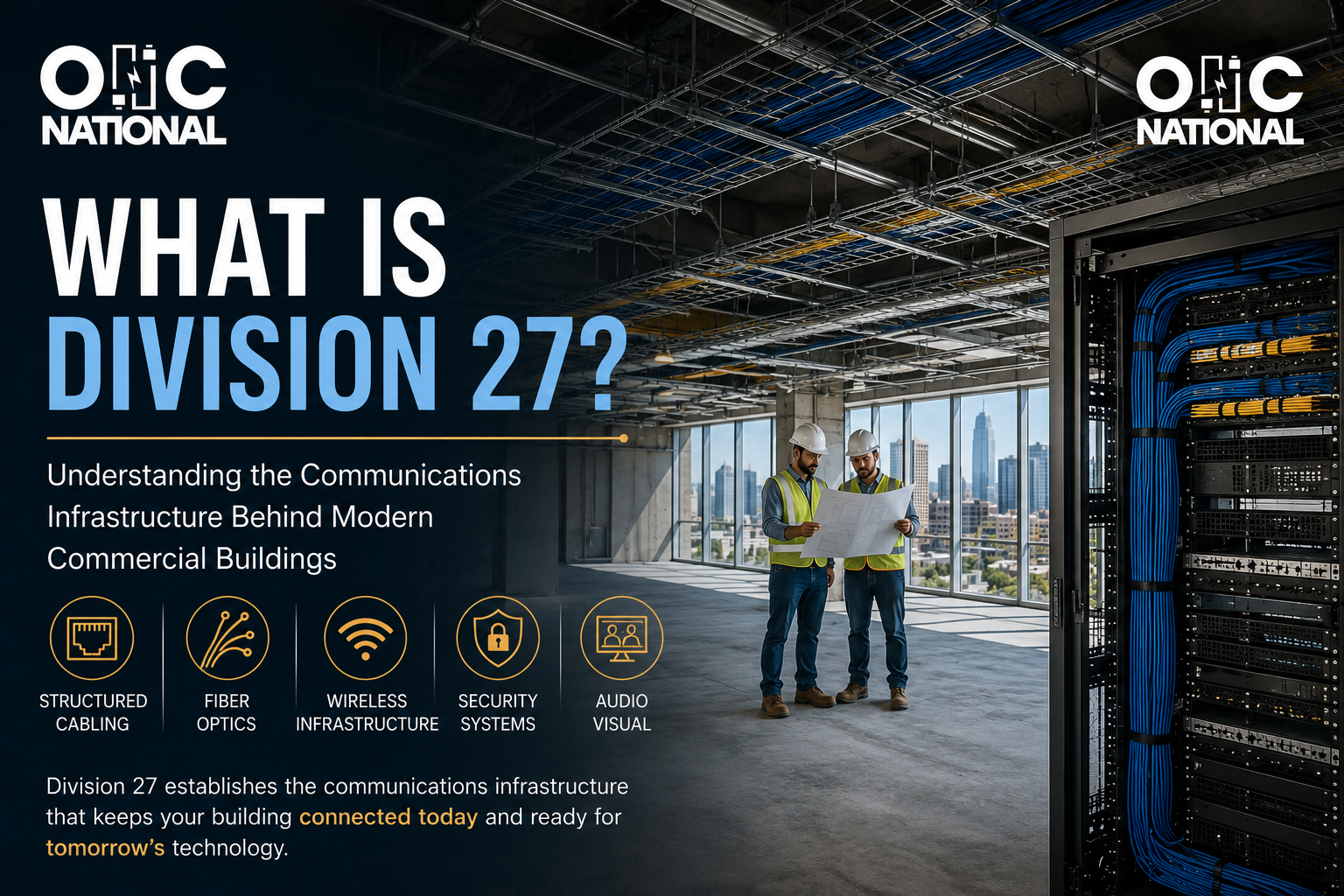
Understanding the Communications Infrastructure Behind Modern Commercial Buildings
Long before employees log into a network, patients check in at a hospital, students connect to classroom technology, or security cameras begin recording, the communications infrastructure supporting those systems has already been built.
Most of that infrastructure is never seen by the people who use it every day.
Hidden behind walls, above ceilings, and inside telecommunications rooms, thousands of feet of cabling, fiber optics, pathways, and supporting equipment work together to keep modern buildings connected. Bringing those systems together requires careful planning, clear specifications, and coordination across multiple trades.
The responsibility is typically defined within Division 27, the Communications section of the Construction Specifications Institute (CSI) MasterFormat. It establishes the requirements for the communications infrastructure that supports reliable connectivity, technology integration, and long-term building performance.
Understanding what Division 27 includes is an important step for owners, architects, general contractors, and project teams planning today’s commercial facilities.
More Than a Number in the Specifications
Construction specifications are organized into divisions that define the scope, materials, and performance requirements for every part of a commercial building. While many people are familiar with divisions covering concreate, electrical, or HVAC systems, Division 27 often receives less attention until technology installations begin.
By that point, important decisions have already been made.
Telecommunications rooms have been sized. Pathways have been installed. Conduit has been routed. Ceiling spaces have been coordinated with other trades. Every one of those decisions affects how well a building supports technology throughout its lifespan.
Division 27 provides the framework that helps ensure those decisions are made with communications infrastructure in mind.
ONC Perspective: Communications infrastructure is no longer a convenience. It is part of the operational backbone of every modern commercial building.
What Does Division 27 Typically Include?
Although every project has unique requirements, Division 27 generally includes the communications infrastructure that supports the technology systems operating throughout a commercial building.
Structured Cabling
Structured cabling serves as the foundation for nearly every connected device inside a building.
Computers, wireless access points, IP phones, printers, building automation systems, and many other technologies all rely on an organized cabling system designed for performance, reliability, and future expansion.
Rather than installing cables only where they are immediately needed, structured cabling creates a standardized infrastructure that allows organizations to adapt as technology changes.
Related Reading: What is Structured Cabling? The Foundation Behind Every Successful Commercial Building.
Fiber Optic Infrastructure
As buildings continue to generate and process more data, fiber optic cabling has become an essential part of commercial communications infrastructure.
Fiber provides the high-speed backbone that connects telecommunications rooms, network equipment, and building across larger campuses. It offers greater bandwidth, supports longer distances, and creates flexibility for future technologies that demand faster connectivity.
Planning for fiber today often helps organizations avoid expensive upgrades tomorrow.
Network Infrastructure
Every network depends on more than switches and servers.
Division 27 commonly addresses the physical infrastructure that supports those devices, including telecommunications rooms, equipment racks, cable management systems, patch panels, backbone pathways, and horizontal cabling.
When these elements are properly coordinated, network equipment can be installed, maintained, and expanded more efficiently throughout the life of the building.
Wireless Infrastructure
Reliable wireless coverage begins during design, not after construction.
Today’s offices, hospitals, schools, warehouses, and manufacturing facilities all depend on consistent wireless connectivity. Planning cable pathways, access point locations, and supporting infrastructure early help improve coverage while reducing the need for future modifications.
Wireless technology changes quickly, but thoughtful infrastructure planning helps buildings adapt without major disruption.
Audio Visual Systems
Conference rooms have evolved far beyond projectors and presentation screens.
Modern collaboration spaces rely on integrated audiovisual technology that supports video conferencing, wireless presentations, digital signage, training environments, and hybrid meetings.
These systems perform best when the supporting communications infrastructure is planned alongside the rest of the building.
Security Infrastructure
Although security devices are commonly specified under Division 28, they often rely on the communications infrastructure established in Division 27.
Network connectivity, fiber backbones, pathways, telecommunication rooms, and supporting cabling all help security cameras, access control systems, and other connected technologies communicate reliably throughout a facility.
When Division 27 and 28 are coordinated together, projects typically experience fewer installation conflicts and better long-term performance.
What Should Division 27 Specifications Define?
One of the most common misconceptions is that Division 27 only identifies which cables should be installed.
In reality, effective specifications establish expectations for the entire communications infrastructure.
Depending on the project, Division 27 documents may include:
· Scope of work
· System performance requirements
· Copper and fiber cabling types
· Telecommunications room layouts
· Equipment rack requirements
· Cable pathways and conduit systems
· Labeling standards
· Testing requirements
· Documentation requirements
· Commissioning procedures
· Warranty requirements
· Coordination responsibilities between trades
Clear specifications help everyone involved understand exactly what is expected before construction begins, reducing uncertainty and improving coordination throughout the project.
Why Early Planning Matters
Communications infrastructure intersects with nearly every major building system.
Electrical contractors, mechanical contractors, architects, structural engineers, security integrators, and audiovisual specialists all influence how technology is ultimately installed.
When communications infrastructure is considered early in design, project teams have more opportunities to coordinate pathways, equipment spaces, and future capacity before construction progresses too far.
Waiting until installation begins often results in redesign, additional labor, schedule impacts, and avoidable change orders.
Ready to Plan Your Next Commercial Project?
Communication Infrastructure affects far more than network performance. It influences coordination, project efficiency, long-term operating costs, and a building’s ability to support future technology.
Whether you are developing specifications, preparing for construction, or planning a renovation, early collaboration helps create stronger outcomes.
Connect with ONC National to discuss your next commercial technology infrastructure project.