Construction Inclusion Week: Building an Industry People Want to Join
Construction has a people problem. We need more skilled workers. We need the next generation to see construction as a real career. We need experienced people to pass along what they know before they leave the industry. But finding more people only solves part of the problem. We also have to give them a reason to stay.
That means looking beyond recruiting and asking harder questions about the companies we are building. Can people see a future here? Are we developing them? Do they feel comfortable speaking up? Are we creating opportunities for new people and businesses to get in the door?
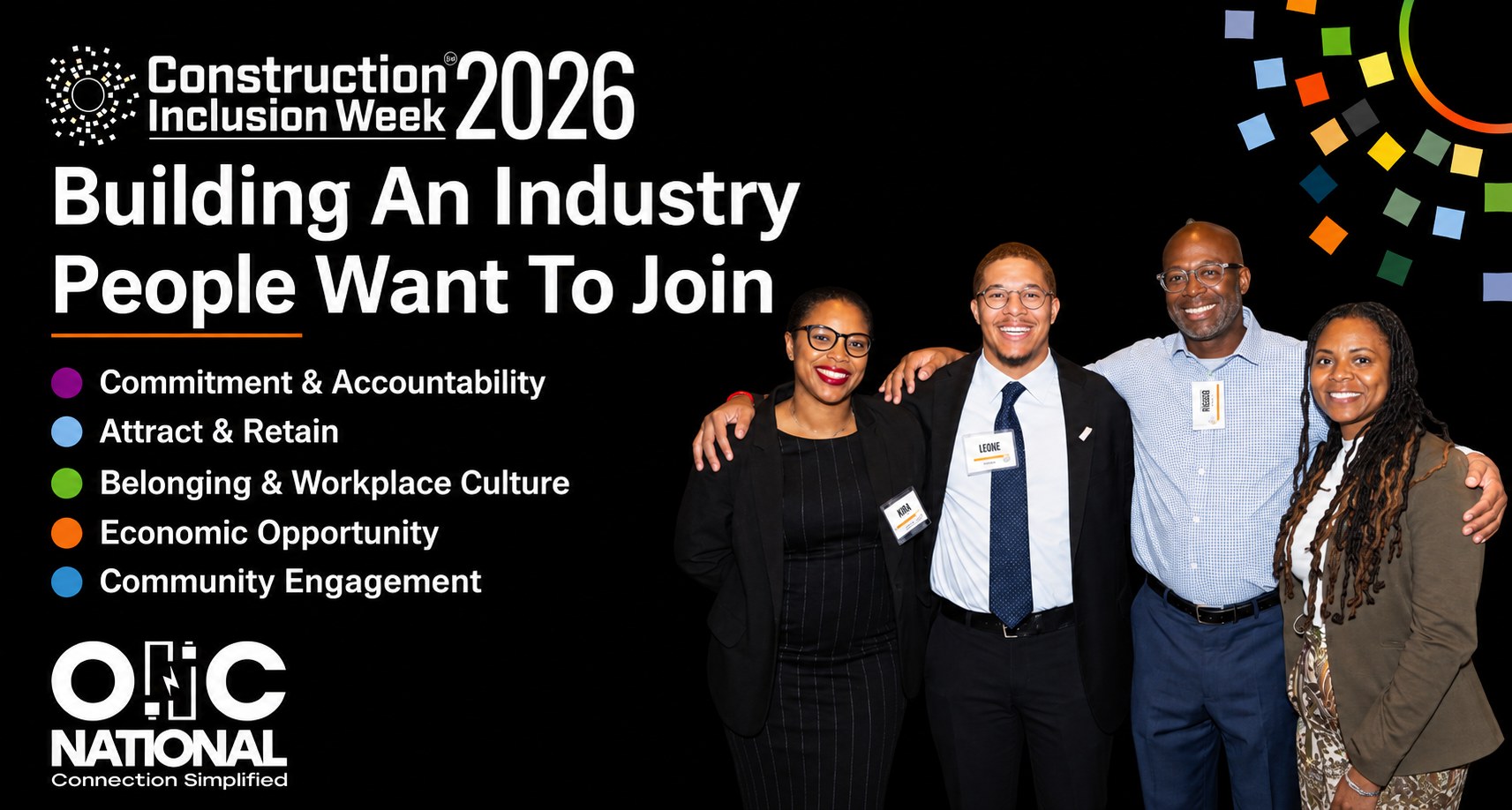
Those questions are at the heart of Construction Inclusion Week. The 2026 theme, Opening Doors, Building a Workplace for Everyone, focuses on strengthening the construction industry by investing in people, expanding opportunity, and creating workplaces where people can grow.
CIW’s five guiding pillars, Commitment & Accountability, Attract & Retain, Belonging & Workplace Culture, Economic Opportunity, and Community Engagement, give the industry a practical framework for doing that.
Not as five boxes to check, but as five ways to build stronger companies.
Give Good People a Reason to Stay
Construction spends a lot of energy trying to find good people. Keeping them deserves just as much attention.
According to the U.S. Bureau of Labor Statistics, construction and extraction occupations are projected to grow 5.2% between 2024 and 2034, compared with 3.1% across all occupations. BLS projects an average of approximately 649,300 openings in construction and extraction occupations each year over that period.
That makes recruiting important. It makes retention just as important.
People are more likely to see a future with a company when they can see themselves progressing within it. That might mean learning from an experienced technician, getting exposure to another part of the business, or being trusted with more responsibility.
Formal programs can help. The U.S. Department of Labor’s Apprenticeship.govdescribes Registered Apprenticeships as a proven way for construction employers to recruit, train, and retain talent. In 2025 alone, more than 480,000 apprentices were served in the construction industry.
Knowledge only strengthens an industry when someone passes it on. That is where Attract & Retain becomes real.
Build a Culture Where The Best Idea Can Win
A strong workplace is not where everyone agrees. It is one where people can contribute.
Think about what happens when a newer employee questions how something is done. Or when someone in the field sees a problem that wasn’t obvious during planning. Does the team listen?
Construction relies on people catching problems, asking questions, and finding better ways forward. A culture where people are reluctant to speak up can leave valuable experience and ideas sitting on the sidelines.
Belong & Workplace Culture and Commitment & Accountability come together here.
Leaders set the tone, but employees experience the culture through everyday moments. How are questions received? How are mistakes handled? Who gets trusted with bigger responsibilities? Do leaders follow through on what they say matters?
Those answers tell you more about a company’s culture than a statement on a wall ever will.
Don’t Let Your Network Become a Closed Circle
Relationships matter in construction. When you find a subcontractor, supplier or partner who consistently performs, you call them again. That is good business. The problem comes when familiarity becomes the only way in.
There are capable businesses trying to earn their first opportunity with companies that don’t know them yet. There are professionals with the skills to succeed who may not have the relationships that traditionally open doors.
That is where Economic Opportunity, one of Construction Inclusion Week’s five guiding pillars, comes to play.
That doesn’t mean lowering the bar.
It means widening the starting line.
Qualified companies should still have to perform. Employees should still have to earn greater responsibility. Standards still matter. But a strong industry needs room for the next great subcontractor, supplier, technician or project manager to emerge.
Every trusted relationship had a first project.
Show People the Construction Industry They Don’t Know
Construction has an awareness problem. People can’t pursue careers they don’t know exist.
Someone interested in technology, for example, might immediately think about software development, cybersecurity or IT. They may never realize that construction needs people working with fiber, structured cabling, wireless infrastructure, security, audiovisual systems, and connected buildings.
That is only one corner of an enormous industry.
There are careers in estimating, engineering, project management, design, the skilled trades, technology, and countless specialities that many students and career changers rarely see.
That is why Community Engagement matters.
Construction Inclusion Week’s 2026 focus specifically calls on the industry to make long term construction career pathways more visible and accessible. That can happen through relationships with schools, technical programs, apprenticeship programs, and community organizations.
Those connections are not only about filling today’s open positions. They give people a chance to see what this industry looks like and where they might fit within it.
You don’t know which conversation, jobsite visit, or introduction will change someone’s idea of what their future could look like. But first, someone has to make the introduction.
Build the Company People Want to Find
CIW gives the industry five pillars, but they point toward something bigger. Build companies where people can learn from those who came before them. Create teams where people can contribute what they know. Keep the door open for qualified people and businesses that haven’t had their first opportunity yet. Show the next generation how many possibilities exist inside this industry. And hold ourselves accountable for making those things part of how we operate, not simply what we say.
That kind of company doesn’t just attract people. It builds people. And those people eventually become the supervisor, mentors, project managers, technicians, tradespeople and business owners who create opportunities for generations behind them.
Construction Inclusion Week gives us a reason to take a closer look at the industry we are building. The real opportunity is what we choose to do next.
Open a door. Develop someone. Expand your circle. Make one change that lasts beyond the week.
Because a stronger construction industry isn’t something we wait for, it is something we build together.
Ready to build what is next? Connect with ONC National.