

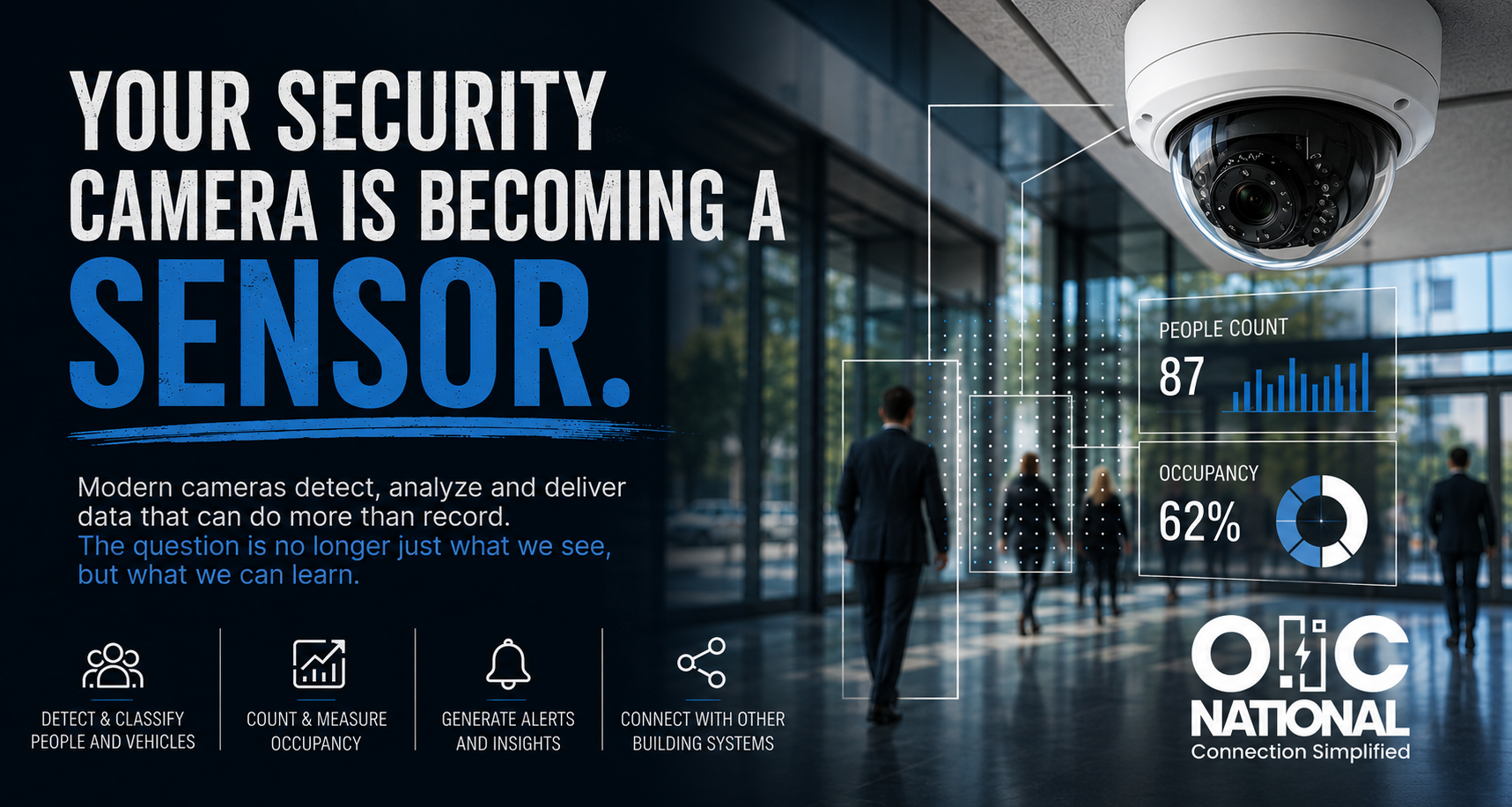
For years, a security camera had a pretty straightforward job. Watch the door. Record the parking lot. Keep an eye on the hallway. If something happened, someone could go back and look at the footage.
That job hasn’t disappeared, but the camera hanging from the ceiling today may be capable of doing something very different. It can detect and classify people and vehicles. It can count objects crossing a defined line. It can monitor occupancy within an area. It can turn what it sees into data that can trigger alerts, support analysis and provide information about how a space is being used.
In other words, the security camera is becoming something else. It is becoming a sensor. This changes the questions we should be asking about cameras in commercial buildings.
A Camera Doesn’t Have To Just Record Anymore
The difference between a camera and a sensor used to be easy to understand.
A camera captures an image.
A sensor detected a condition.
That line is getting harder to see.
Modern video analytics can detect, classify, track, and count people and vehicles. Depending on the system and application, cameras can also monitor things such as line crossings, time spent in an area and occupancy levels.
So the camera overlooking an entrance can still answer:
Who came through the door? But now it may also help answer:
How many people came through the door?
When was the entrance busiest?
Did someone enter an area where they shouldn’t be?
That is more than video, it is information. Once cameras begin producing information about what is happening inside and around a building, their potential role gets much bigger.
What Do We Want The Building To Know?
This may be the more important shift. When cameras are planned primarily for security, the obvious question is, what do we need to see?
Where are the entrances? Where are the vulnerable areas? Where do we need visibility? Those questions are not going away, however another question belongs in the conversation now.
What do we want the building to know?
Think about an entrance. From a security perspective, you want to see who comes through it. From an operational perspective, information about how that entrance is used may tell you something. The same could be true of a parking area, corridor, loading dock or common spaces.
That doesn’t mean every security camera should become an analytics tool. It does mean we should stop assuming that a camera has only one possible job.
The location of a camera may determine not only what you can see, but also what you can learn.
A Smart Building Isn’t Just A Building With More Technology
Commercial buildings already generate enormous amounts of information.
Cameras know something.
Access control knows something.
Lighting controls know somethings.
Environmental sensors know something.
The network knows something.
The real opportunity comes from what happens to that information.
Cisco describes smart buildings as environments where systems including HVAC, lighting, security and life safety operate across shared digital infrastructure. Sensors and connected devices generate information about occupancy, equipment, environmental conditions and access activity, and smart building systems can use shared data to coordinate actions rather than leaving information isolated inside individual systems.
That’s an important distinction. If every system knows something but none of them can communicate, you have a lot of technology. You don’t necessarily have a smart building.
The goal is not simply to install more devices. It is to make the information those devices produce useful. Increasingly, the camera can be part of that conversation.
The Camera Changed, The Infrastructure Conversation Should Too
There is still something decidedly unglamorous behind all this intelligence. The network.
A camera capable of analytics is still a connected endpoint. It needs connectivity, power and a network designed to support what you are asking it to do.
Power of Ethernet already allows network infrastructure to provide both connectivity and power to devices such as cameras and other smart building technology. Cisco’s current smart building guidance specifically places cameras and sensors among the connected systems that rely on the network as a foundation.
That doesn’t mean every project suddenly needs more infrastructure. It means the conversations should start with the use case, not simply the device count.
Don’t Just Plan For What You Want To See
Security cameras will continue doing the job we have always expected them to do, but that is no longer necessarily where their value ends. As video analytics become more capable, the familiar camera on the ceiling can become another source of information about what is happening throughout a facility. This gives project teams a new way to think about camera planning.
Don’t only ask, what do we need to see? Start asking, what do we want the building to know?
Because the camera you are installing today may spend the next several years doing far more than just watching the door.
Build The Infrastructure Behind The Intelligence
The smarter our building technology becomes, the more important it is to think about how those devices connect, communicate, and fit into the larger technology environment.
Planning a new project or technology upgrade? Connect with ONC National early, while you still have options behind the walls.