
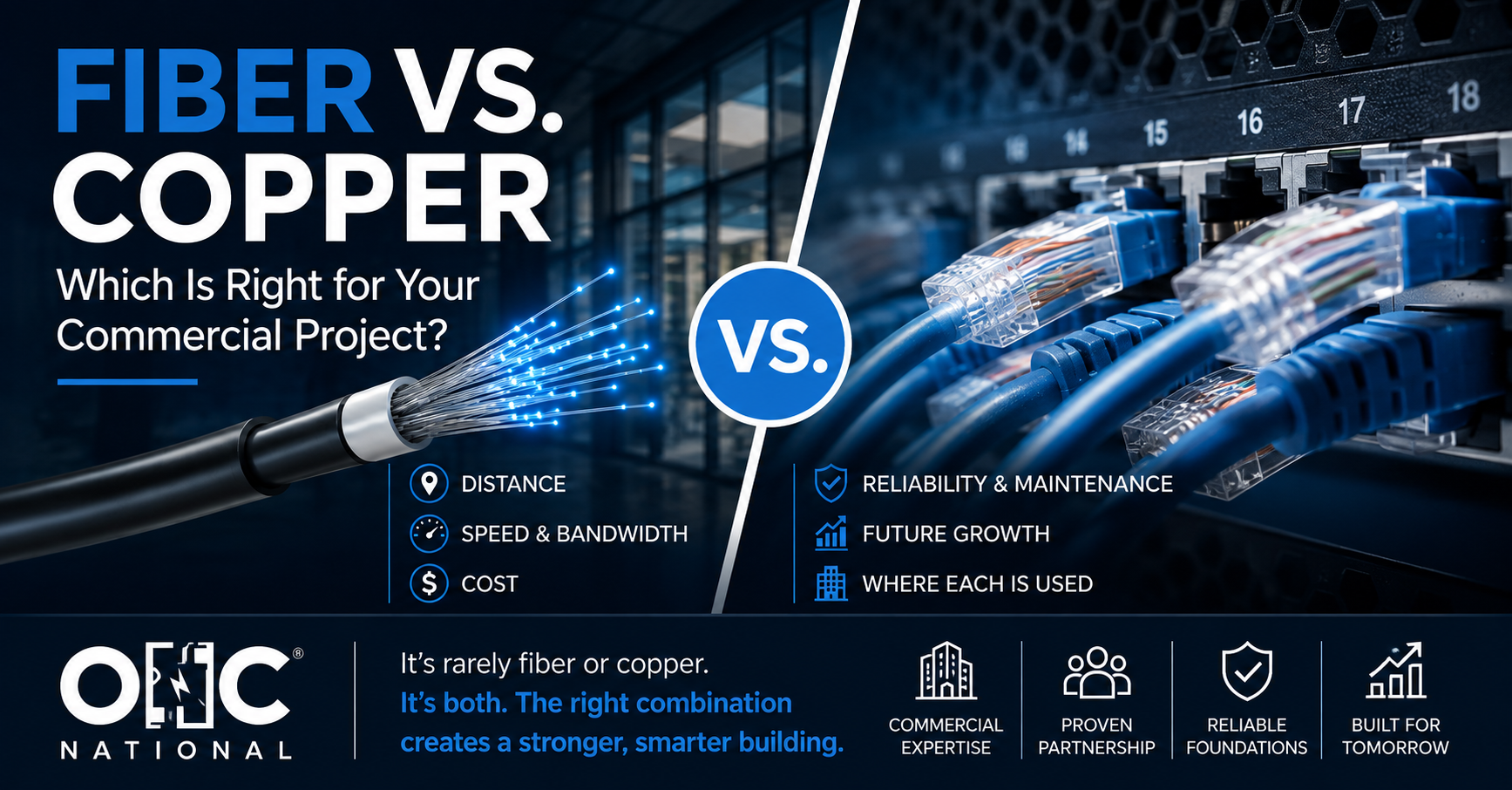
Fiber vs. Copper: Which Is Right For Your Commercial Project?
If you are planning a new commercial building or a major renovation, one of the most important technology decisions you will make isn’t the brand of your network equipment. It is the infrastructure that supports it.
One of the first questions we hear from owners, architects, engineers, and general contractors is: Should we install fiber cabling or copper?
It is a fair question, but it isn’t always the right one. In most commercial building, the answer isn’t fiber or copper, it is fiber and copper.
Each serves a different purpose, and understanding where each fits can help you make smarter decisions during design and avoid costly changes later in the project.
Understand the Difference
Although both fiber optic and copper cabling move data across a network, they do it in very different ways.
Copper cabling transmits data using electrical signals and has been the backbone of Ethernet networks for decades. Today, CAT 6A copper remains the standard for connecting workstations, wireless access points, IP phones, security devices, and many other end-user technologies throughout commercial buildings.
Fiber optic cabling uses pulses of light instead of electricity. Because light experiences significantly less signal loss over distance and isn’t affected by electromagnetic interference, fiber has become the preferred choice for building backbones, campus connections, and other high-capacity network applications.
Both technologies are critical. They simply solve different problems.
Distance Matters
One of the biggest differences between fiber and copper is how far they can reliably carry data.
Copper Ethernet cabling is typically designed for runs up to 100 meters (328 feet). Beyond that distance, signal quality begins to degrade and network performance can suffer. TIA standards establish these distance limitations for balanced twisted-pair cabling in commercial buildings.
Fiber optic cabling can carry data over much greater distances while maintaining exceptional performance. That is why it is commonly used to connect telecommunications rooms on different floors, separate buildings across a campus, or facilities located miles apart.
ONC Perspective: If your project spans multiple floors or multiple buildings, fiber should be part of the conversation from the beginning.
Speed and Bandwidth
Today’s commercial buildings generate far more data than they did just a decade ago.
Video conferencing, cloud applications, AI enabled security cameras, building automation systems, wireless devices, and IoT technologies all compete for network capacity.
Fiber provides significantly more bandwidth and offers a clear path for future growth as technology demands continue to increase. Copper, however, remains more than capable of supporting high-speed Ethernet connections to individual devices throughout most commercial facilities.
The goal is not to replace copper, it is to use each technology where it performs best.
What About Cost?
This is often where conversation begins.
Fiber optic cable itself can cost more than copper, and installation requires specialized equipment, testing, and experienced technicians. However, looking only at material costs rarely tells the full story.
For longer distances, fiber often becomes the more practical and cost-effective solution because it eliminates the need for intermediate network equipment and supports future expansion without replacing the backbone.
The better question isn’t:
“Which one is cheaper?”
It is:
“Which one delivers the best long-term value for this building?”
Planning for the Future
Commercial buildings are expected to last for decades. The technology inside them won’t.
Every year, organizations rely on more connected devices, higher wireless capacity, greater data throughput, and smarter building systems. A communication infrastructure designed only for today’s needs can quickly become tomorrow’s limitation.
That is the reason industry standards continue to evolve to support higher-performance cabling and increased connectivity for technologies like wireless access points and intelligent buildings.
Planning for growth during construction is almost always less disruptive and less expensive than retrofitting an occupied building.
Maintenance and Reliability
Both fiber and copper are reliable when they are properly designed, installed, tested, and documented.
Copper has long been trusted for horizontal cabling because it is straightforward to terminate, troubleshoot, and support.
Fiber offers additional advantages in environments where electrical interference is a concern because it carries light rather than electrical current. That makes it well suited for manufacturing facilities, healthcare environments, data centers, and other locations where network reliability is especially important.
Regardless of the media, long-term performance depends just as much on quality installation and documentation as it does on the cable itself.
Where Each Technology Works Best
In most commercial projects, fiber and copper complement each other.
Copper is commonly used for:
Workstations
Wireless Access Points
IP Phones
Security Cameras
Access Control Devices
Building Automation Endpoints
Fiber is commonly used for:
Building Backbone Connections
Telecommunications Room Interconnections
Campus Environments
Data Centers
High-Bandwidth Network Links
Long-Distance Connections
Choosing where each belongs is one of the most important decisions made during the design phase.
It Is Rarely Fiber or Copper
The strongest commercial networks are not built around one technology. They are built around the right combination of technologies.
Fiber delivers the speed, capacity, and scalability needed for a modern network backbone.
Copper provides reliable, cost-effective connectivity to the devices people use every day.
When planned together, they create an infrastructure that is ready for today’s operations and tomorrow’s technology.
Building The Right Foundation
Every commercial project is different, and there is no one-size-fits-all solution for communications infrastructure.
The right design depends on your building, your operational goals, and where you expect your technology needs to be years from now.
At ONC National, we work with owners, architects, engineers, and general contractors to design and install communications infrastructure that supports long-term performance, scalability, and reliability.
If you are planning a commercial construction project or renovation, we welcome the opportunity to help you build the right foundation from the start.
Connect with ONC National to discuss your upcoming commercial technology infrastructure project.