

For years, the parking garage was fairly simple from a technology standpoint.
Lighting. Cameras. A gate. Maybe access control.
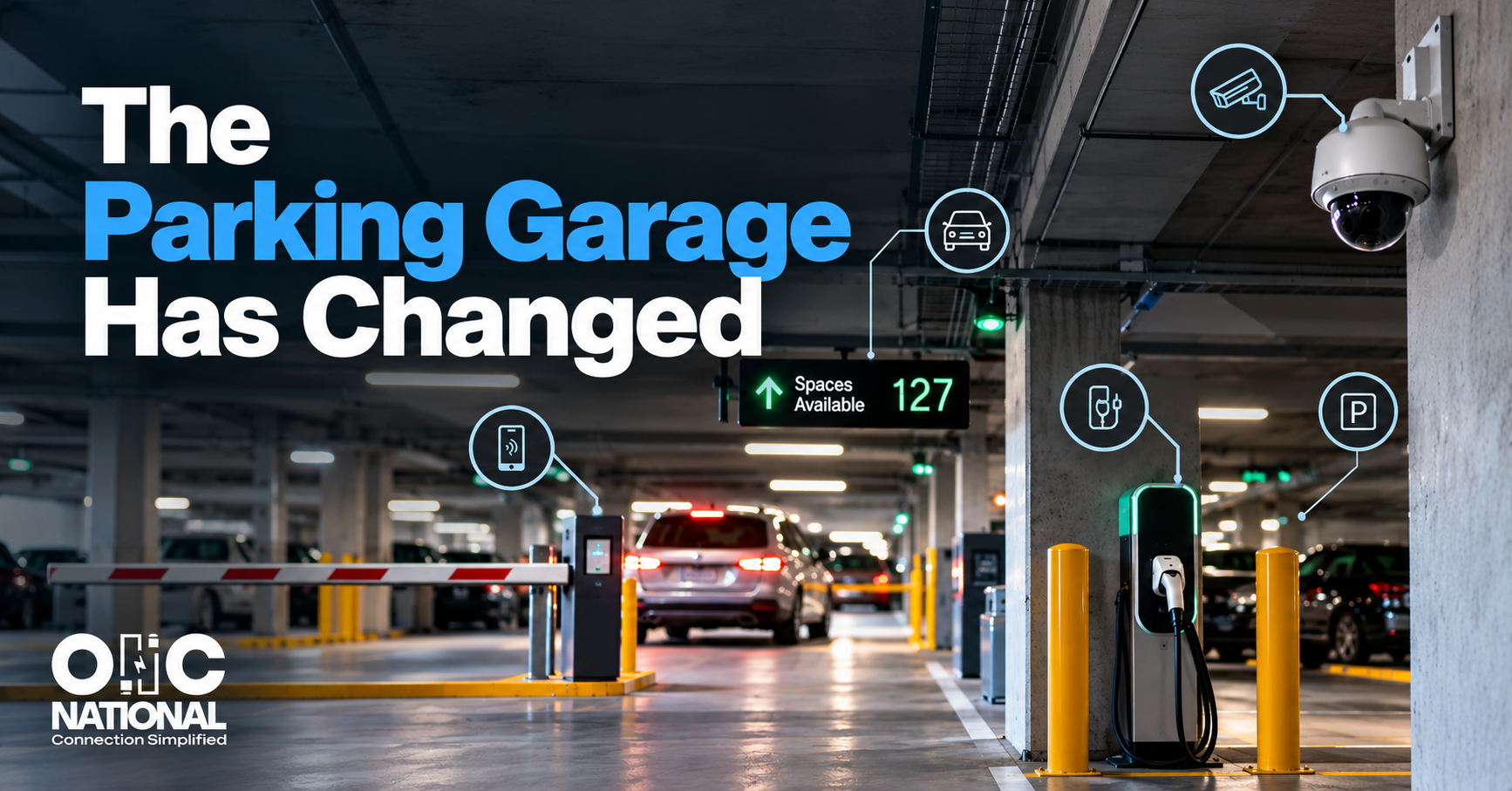
Today, the same garage may include EV chargers, license plate recognition, occupancy sensors, mobile access, payment systems, digital signage, and more advanced security systems.
The garage hasn’t just gotten smarter. It has become part of the building’s technology environment.
More Technology Means More Infrastructure
Consider what can happen before someone even parks.
A driver enters using a mobile credential. A camera reads the license plate. A system tracks available spaces. An EV charger communicates with a management platform.
Behind each of those experiences are infrastructure decisions.
How will the systems connect? Where will equipment be located? Is power available? Are there pathways to support it? What happens when another device is added later?
Those questions are much easier to answer during design than after construction.
EV Charging is a Good Example
EV Chargers illustrate how quickly the garage has changed.
Networked chargers can support payment processing, user authentication, remote monitoring, software updates, and energy management. That means planning may involve more than electrical capacity. Connectivity, cybersecurity, and future expansion can matter too.
A property might need 10 chargers today and significantly more in the future. The challenge is making sure today’s infrastructure doesn’t unnecessarily limit tomorrow’s options.
Camera Have Changed Too
Security cameras aren’t necessarily just recording video anymore.
Depending on the system, they may support license plate recognition, analytics, or integration with other security and parking platforms.
So instead of only asking where the camera should go, project teams also need to ask what it will need to function as intended.
That could mean power, connectivity, bandwidth, storage, or integration with other systems.
Don’t Plan Only For Today’s Garage
No one knows exactly what a parking garage will need ten years from now. That is not the point.
The goal is to leave enough flexibility that adding the next camera, charger, sensor, or connected system doesn’t become a major infrastructure problem.
That requires thinking about pathways, connectivity, equipment capacity, and expansion before every future device has been selected.
Because while the garage may still look like concrete, striping and parked cars, what is happening behind the scenes has changed considerably.
Technology planning can’t stop at the building’s doors anymore.
The parking garage has changed. The infrastructure behind it needs to change with it.
ONC National helps project teams plan technology infrastructure that works for what buildings need today while leaving room for what comes next. Connect now.