

The Technology Graveyard Hiding Inside Commercial Buildings
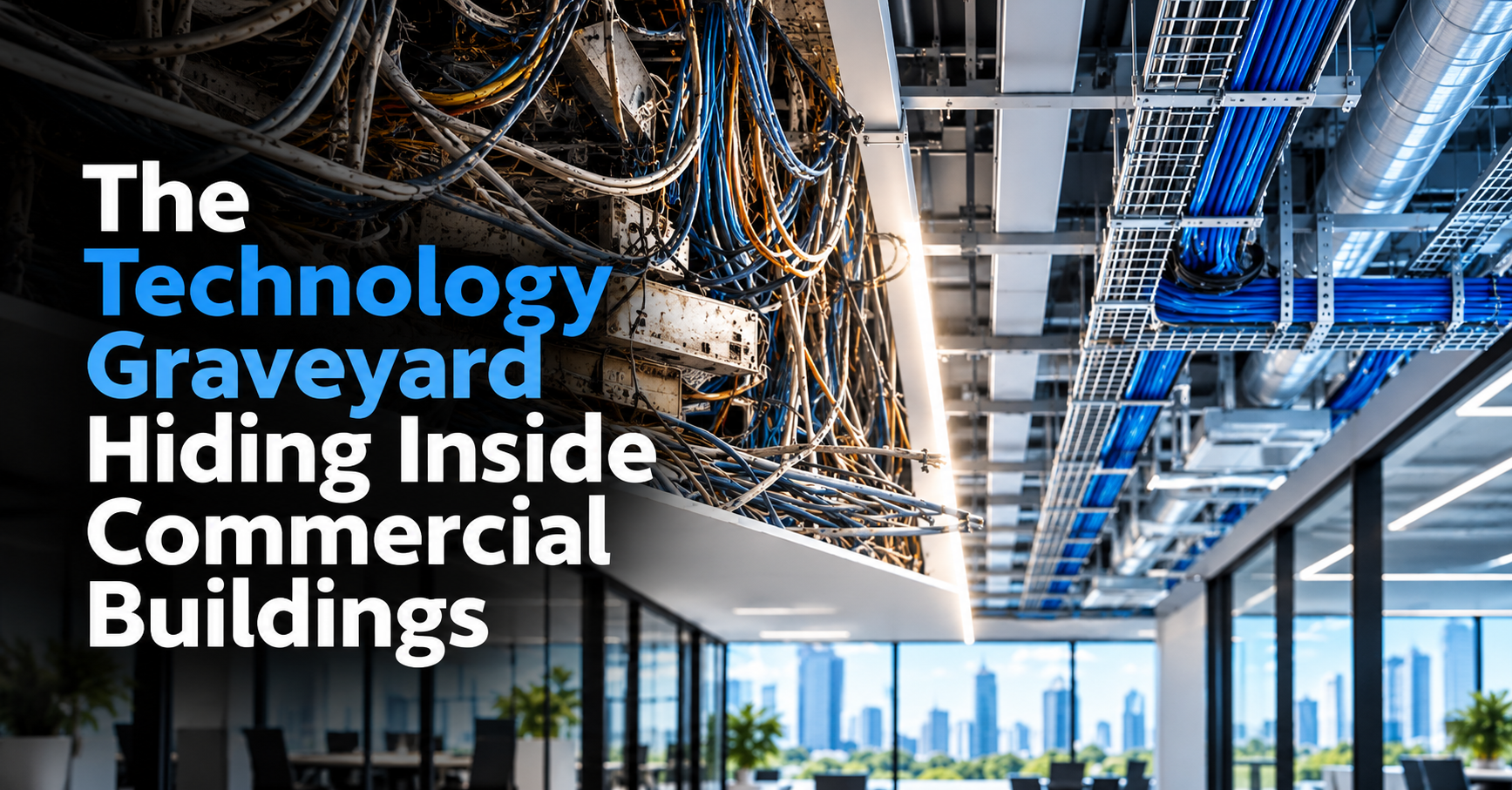
Above the ceiling of an older commercial building, you can often see decades of technology decisions.
Copper and fiber from previous network installations. Security cabling from systems that have been replaced. Disconnected equipment still occupying rack space. Patch panels nobody can confidently identify. Infrastructure installed for tenants that left years ago. Most of it is invisible during normal building operations.
It becomes much harder to ignore when the next renovation or technology upgrade begins.
What Gets Left Behind
Commercial technology does not get replaced all at once. A building may upgrade its surveillance system while retaining access control. Wireless infrastructure may be replaced without touching older horizontal cabling. Tenants improvements may introduce entirely new systems while portions of previous installations remain.
Over time, active, inactive, and unidentified infrastructure begin sharing the same pathways, ceilings, and telecommunications rooms.
The result is more than clutter. It creates uncertainty.
Before engineers and contractors can determine what can be reused, relocated, or removed, they first have to establish what is actually serving the building.
That investigation can affect scope, schedule, and cost before the new system is even installed.
The Cost Of Not Knowing What You Have
Consider a pathway that appears to have no capacity for additional cable.
Is it actually full?
Or is a significant portion occupied by infrastructure that has been abandoned for years?
The same question applies inside a telecommunications room. A crowded rack does not necessarily indicate that the building needs another rack. It may indicate that obsolete equipment was never decommissioned.
Without accurate records, someone has to find out.
Technicians trace cables. Equipment is tested. Above-ceiling conditions are investigated. Existing drawings are compared with what is physically installed.
That is technical debt in a very physical form.
The building is paying today for infrastructure decisions that were never fully closed out.
There Is Also A Code Question
Abandoned cabling should not automatically be treated as harmless simply because it is no longer connected.
Requirements for abandoned communications and optical-fiber cabling are addressed within the National Electrical Code, and the specific requirements depend on the cable, installation and code adopted by the jurisdiction.
For project teams, the larger point is simple: abandoned infrastructure should be identified during planning, not discovered after construction begins.
A proper existing-conditions assessment can help determine what is active, what may be reused, what should be removed and what requires further investigation.
Look Beyond The Devices
Technology planning often begins with the visible system.
How many cameras are needed? Where will wireless access points go? What access control devices are being replaced? What new building systems will connect to the network?
Those are necessary questions, but they come later than another set of questions:
What pathways are available?
What is the condition of the existing cabling?
Is there sufficient rack space?
Are power and cooling adequate?
Are telecommunications spaces being used for their intended purpose?
Do the drawings reflect what is actually in the building?
Those conditions can determine whether an otherwise straightforward technology project remains straightforward.
Renovations Is A Chance To Reset
Renovations create one of the best opportunities to address accumulated technology infrastructure.
Ceilings are already open. Systems are being evaluated. Contractors are mobilized. New pathways may already be part of the work.
This is the point when project teams can remove infrastructure that no longer serves the building, document what remains and make deliberate decisions about capacity for future systems.
That last piece matters.
Commercial buildings are adding more connected devices, not fewer. Cameras, access control, wireless networks, sensors, audiovisual systems and building controls all compete for pathways, telecommunications space, power and network capacity.
Simply installing another layer is not a long-term infrastructure strategy.
Before The Next Upgrade
The technology graveyard inside a building usually was not created by one bad project.
It developed gradually as systems changed and yesterday's infrastructure was left for someone else to address.
That makes the existing environment worth examining before the next system is designed.
Not just the devices.
The pathways. The cabling. The racks. The documentation. The infrastructure nobody has thought about in years.
Because sometimes the first step in modernizing a building is figuring out what should no longer be there.