

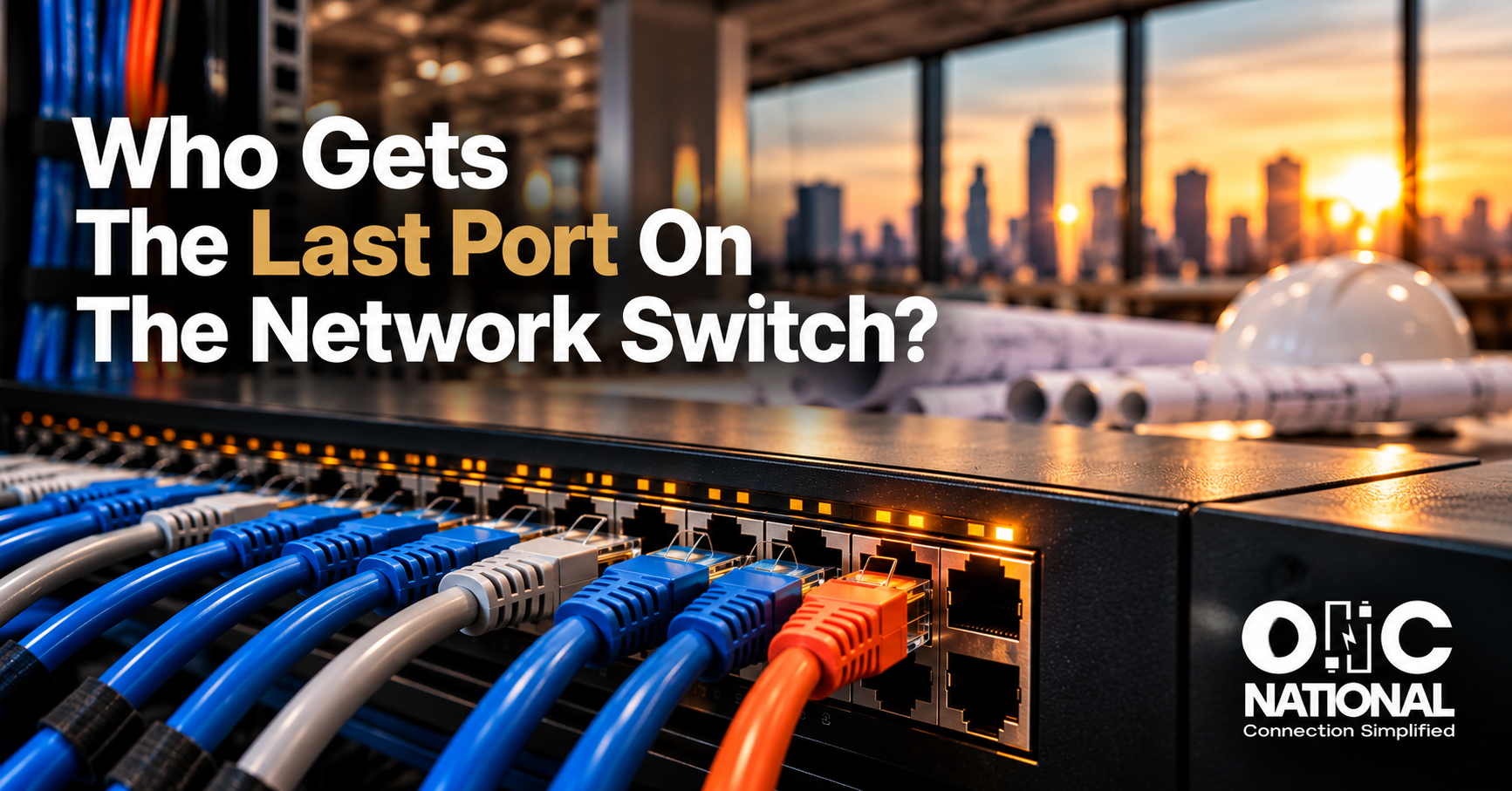
There is one port left.
Security needs another camera. The wireless team needs another access point. Access control needs another connection.
Everyone has a reason they need it.
So who gets the last port?
It sounds like a technology question, but it is actually a planning question.
Because if a project team is deciding which device gets the last available connection, the bigger issue is that the building has no room left to change.
And buildings change.
The Drawings Are Rarely The Final Word
A project may start with a clearly defined technology scope. Then reality happens.
A camera gets added. Coverage needs change. Another door requires access control. Digital signage enters the conversation. A new building system needs connectivity. None of those changes is unusual, but each one depends on infrastructure that has limits.
Network switches have a finite number of ports, and when devices use Power over Ethernet, an available port isn’t the only consideration. The switch must also have enough power capacity to support the connected equipment.
Cisco’s guidance on Power over Ethernet distinguishes between port availability and the total power budget available to connected devices. Cisco Power over Ethernet Configuration Guide.
In other words, an open port doesn’t always mean you have room.
Designing To The Exact Count Creates A Problem
If there are 40 devices on the drawings, designing infrastructure for exactly 40 devices may work on paper. It leaves very little room for reality.
The same applies to rack space, pathways, fiber, cabling, and power. Designing only for what is required today can make a relatively simple addition much more complicated tomorrow. That doesn’t mean overbuilding. It means making a deliberate decision about how much flexibility the building should have.
Spare Capacity Isn’t Wasted Capacity
Unused capacity can be tempting to cut, especially when a project is looking for savings. However, there is a difference between unnecessary infrastructure and intentional capacity.
A little room to grow can make it easier to accommodate the next camera, access point, sensor or connected system without immediately redesigning part of the infrastructure.
You don’t need to predict exactly what will be added five years from now. You just need to expect that something will be.
If You Are Talking About The Last Port, You Are Already Too Late
The better conversation happens before the switch fills up.
How much capacity should remain after opening day? Which systems are likely to expand? Is there enough power for future PoE devices? Can the racks, pathways, and cabling accommodate reasonable growth?
Those decisions are not as visible as the technology people interact with every day. But they determine how easily that technology can change. Because eventually, someone will ask for one more device.
Good technology planning doesn’t try to predict every device a building will ever need. It makes sure the next one doesn’t become a problem.
ONC National helps project teams plan technology infrastructure for what buildings need today while leaving room for what comes next. Connect Now.