

Your Building Has A Technology Traffic Jam
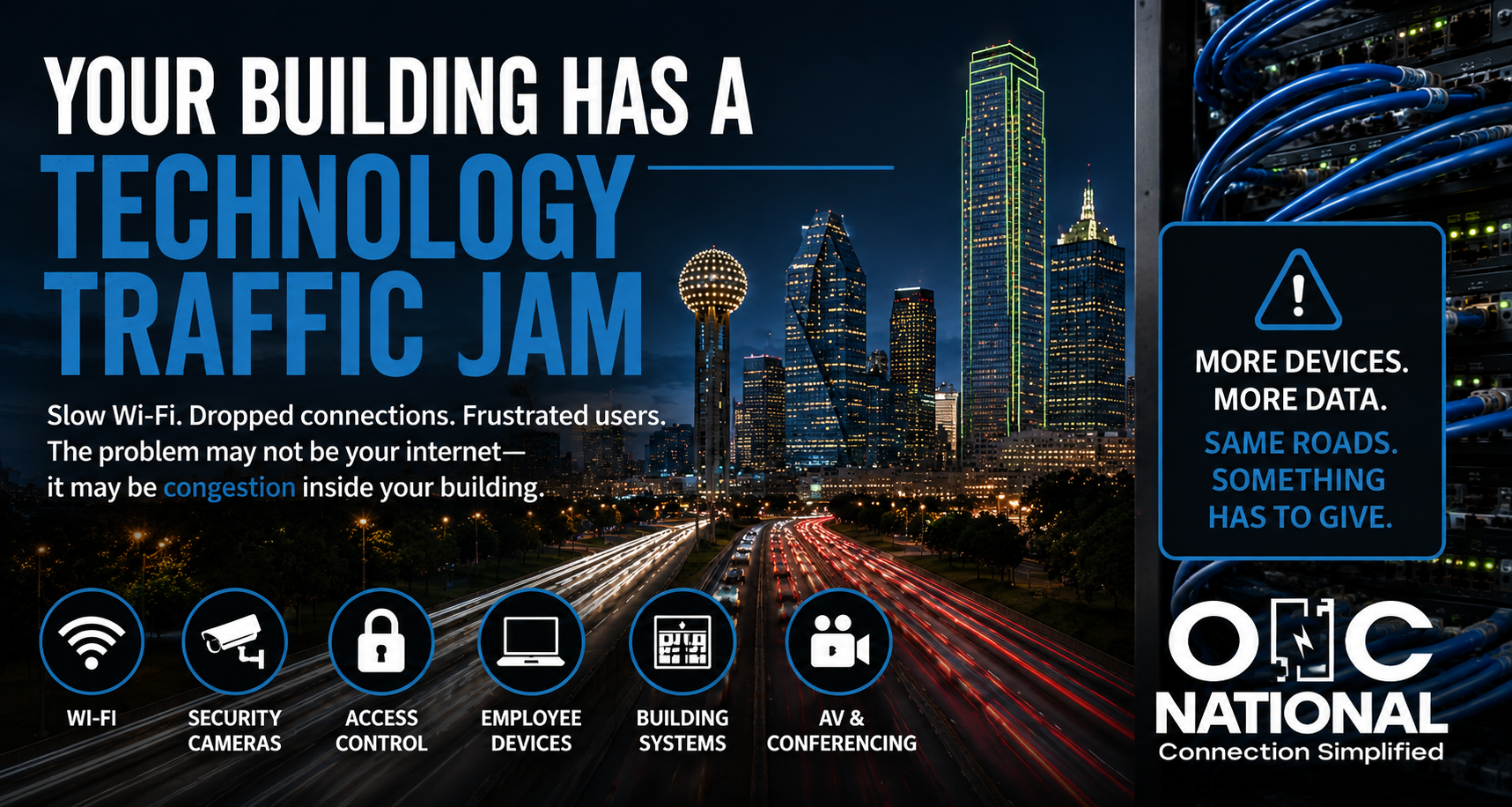
The WiFi is slow.
Video calls freeze.
Security cameras drop offline.
A conference room works perfectly one day and struggles the next.
The first assumption is usually the same: we need faster internet. Maybe, but your internet connection may not be the problem at all.
Your building may have a technology traffic jam.
The Symptoms Show Up Everywhere
Modern commercial buildings move a lot of data. Employees are on laptops and phones. Conference rooms are running video. Security cameras are streaming around the clock. Access control, AV, building systems, and wireless devices are all communicating across the property.
When everything is working, nobody thinks about the network.
When it isn’t, the symptoms can appear unrelated.
Spotty WiFi gets blamed on the access points. A frozen video call gets blamed on the internet provider. A camera going offline gets blamed on the camera. When multiple systems are struggling, it is worth looking at what they have in common.
The network carrying their traffic.
Faster Internet Doesn’t Fix Every Traffic Jam
Think about rush hour. Increasing the speed limit doesn’t help much when the problem is congestion farther down the road. Buildings can have the same problem.
The bottleneck could be an overloaded switch, insufficient uplink capacity, poor network configuration, aging infrastructure, or simply more connected devices than the network was designed to handle.
That distinction matters because replacing equipment without identifying the actual bottleneck can mean spending money and ending up with same problem.
Not All Traffic Is The Same
A guest checking email and a security camera continuously transmitting video do very different thins on a network. So do video conferences, cloud applications, access control systems, and connected building equipment. As more systems become IP based, understanding what is using the network becomes increasingly important.
The National Institute of Standards and Technology (NIST) addresses network segmentation and traffic separation as part of broader cybersecurity guidance, while CISA recommends network segmentation as a way to separate systems and limit unnecessary communication across networks.
Segmentation has important security benefits, but there is a broader lesson here to: every device should not simply be thrown onto a network without considering how the entire environment operates.
Find The Bottleneck Before You Buy The Fix
If technology performance is inconsistent across a building, start with the problem instead of the product.
When did it happen?
Which systems are affected?
Is it isolated to one area or happening throughout the building?
Does performance change when occupancy increases?
Those answers can tell you far more than immediately ordering faster service or new equipment. Because sometimes you don’t need a bigger internet connection. You need to figure out where the traffic is getting stuck.
Technology should work without everyone in the building thinking about it.
Connect with ONC National to identify what is slowing your network down and build the right solution.