
The $10,000 Device Hanging From a $20 Cable
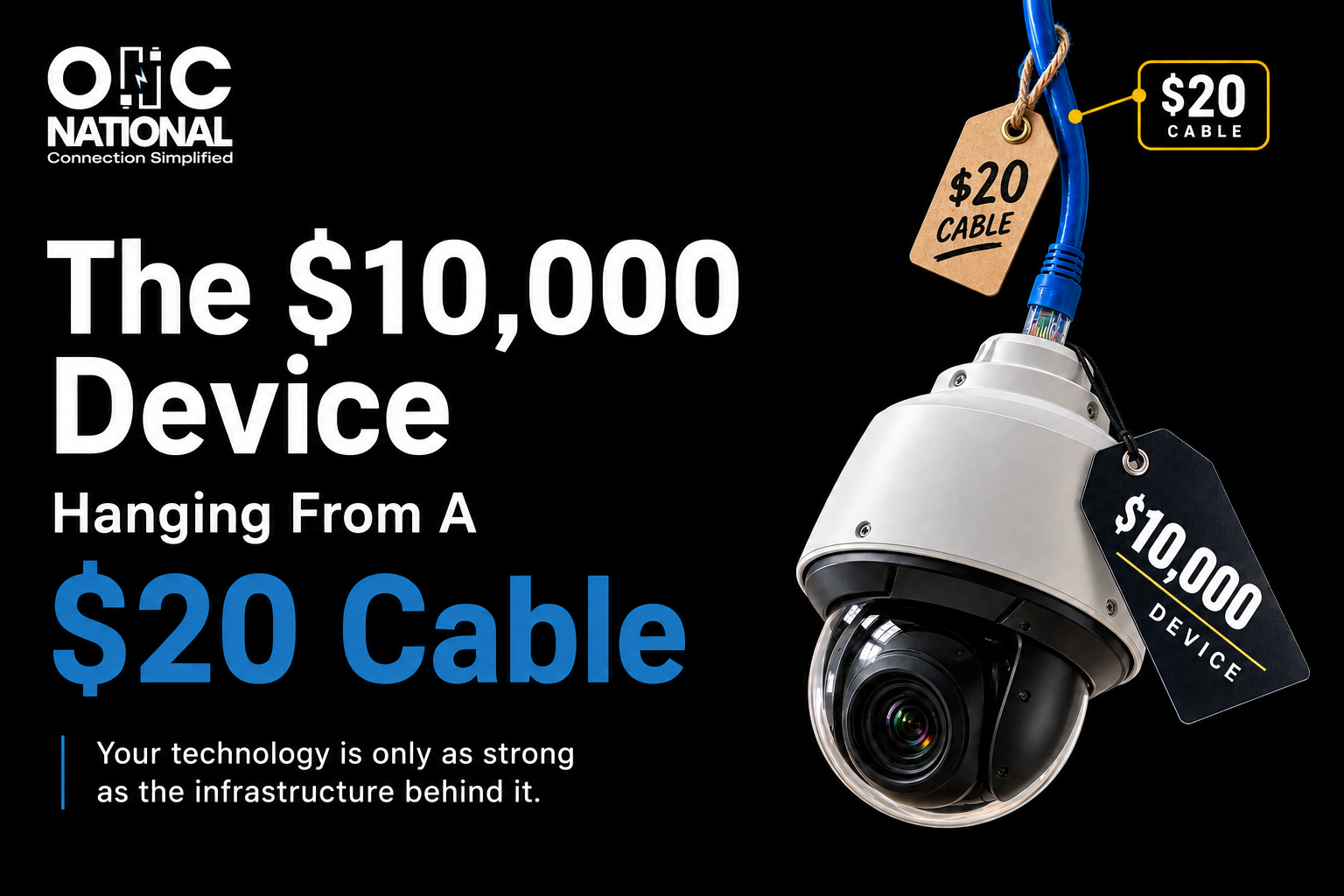
A $10,000 piece of technology gets attention. The cable connecting it usually doesn’t.
We compare cameras by resolution and analytics. We evaluate wireless access points by speed and coverage. We look at what a new display, sensor or access control systems can do. Then we connect that investment to infrastructure that may disappear behind a wall or above a ceiling for the next decade.
That is where an inexpensive decision can become a surprisingly expensive one. Because the real cost of that cable isn’t what you paid for it. It is what happens when it can no longer support the technology connected to it.
The Device Is Only Half The Purchase
Modern building technology ask as lot from the network behind it. A single Ethernet connection can carry data and, through Power over Ethernet (PoE) , power devices such as wireless access points, cameras, sensors, and displays. Higher power PoE has expanded those possibilities even further. Cisco notes that current PoE standards can provide up to 90 watts from the power source, allowing Ethernet to support a much wider range of connected devices.
At the same time, the devices themselves are becoming more demanding.
Consider a current wireless access point. Some WiFi 7 models now have multigigabit Ethernet ports and higher power requirements. Cisco’s deployment guidance for its CW91781 for example, recommends Cat 6 or Cat 6A cabling for best performance and shows that available features and link speeds can change depending on the power supplied to the access point.
The lesson isn’t that every device needs the most expensive cable available. It is that the infrastructure should be selected with the same level of thought as the device.
What Is That Cable Actually Responsible For?
More than most people realize.
The $20 cable in our headline isn’t really the point. The point is the relationship between the cost of the infrastructure and the value of everything depending on it.
A premium device cannot create bandwidth the connection doesn’t support. A PoE powered device cannot draw power the network isn’t equipped to provide. And a future upgrade cannot take advantage of capabilities the existing infrastructure can’t deliver.
The Expensive Part Comes Later
This is the part that deserves more attention during conversation. Installing cable while walls and ceilings are open is one thing. Replacing it after a building is finished, occupied and operating is another.
Now you are dealing with access to finished spaces, ceiling systems, pathways, occupied work areas and potentially disrupted operations. What looked like a small savings during construction can become a much larger retrofit later. And the device lifecycle and infrastructure lifecycle aren’t necessarily the same.
A camera gets replaced. A wireless access point gets upgraded. A new sensor is added. Building technology keeps changing while much of the physical infrastructure remains in place.
Cisco’s physical infrastructure guidance makes this point in its recommendations for wireless networks: higher performance wireless can require more from existing cabling, and the cabled infrastructure should be planned so it does not require significant attention throughout its useful life. That is a better way to think about the investment.
Don’t only ask whether the infrastructure can support what you are installing. Ask whether it gives you somewhere to go next.
Five Questions to Ask Before the Device Goes Up
Before approving another connected device, take a minute to look behind it.
1. What does the device actually require?
Check bandwidth, power and manufacturer cabling recommendations instead of assuming the existing connection is sufficient.
2. What is already installed?
Know the cable category, condition, distance, and available network capacity before planning around it.
3. How will the device be powered?
For PoE equipment, the switch, cabling, and device all have to support the required power level.
4. What might replace this device?
The minimum requirement today may leave fewer options when the equipment is upgraded.
5. What would it take to replace the infrastructure later?
This may be the most important question. A relatively inexpensive component can become costly when replacing it means reopening a finished building.
Spend Where it Matters
This isn’t an argument for buying the most expensive cable. It is an argument for understanding what you are asking the infrastructure to do.
Commercial buildings are adding more connected devices, more PoE and more systems that rely on the network. The equipment will continue to evolve. The infrastructure behind it needs enough capacity, quality, and flexibility to support that evolution.
So the next time a $10,000 device goes on the wall or ceiling, look at what is behind it. The cheapest component in the system shouldn’t become the reason you can’t get the performance you paid for.
Planning a new project or technology upgrade? Connect with ONC National early, while you still have options behind the walls.